Showing posts with label Mathematics. Show all posts

Sunday, 18 October 2015

Free Downloads Updated

I have updated my download page and fixed any broken links.

Please find the latest verion of my downloads here. I will continue adding to this list as I post new material. Please let me know if a link is not working or if there is an error on a file. Feel free to download and use these files but link back to my blog when you share them. Do not copy or sell these files.

Language


Mathematics

Geometry


Science

Organ Cards - post

Monday, 18 August 2014

Infinity Street

Not long ago I was introduced to a brilliant counting activity which has been invented for Montessori classrooms; Infinity Street. This activity is designed to give children the opportunity to practice reading and making numbers beyond a trillion. 


 Each number family is represented in a house on infinity street. In each house lives the units, tens and hundreds. The houses increase with size as the numbers get larger.

The number families represented on this street are, units, thousands, millions, billions, trillions, quadrillions, quintillion, and sextillions. Of course the houses can go on and the numbers can increase but I found that this was sufficient for the children. Each number family name was written on a card which also contained a comma.

This activity is very easy to make. It took me about 40mins to cut all the houses in yellow foam and the colour strips in red, blue and green. 


Here is the activity in use by some children in the lower elementary classroom. The coloured strips are actually made for the beads to fit.  After the child lays out all the houses, they select beads at random or to make a chosen number. Once the beads have been placed in each house, the child practices reading the number using the cards to help. 


In this particular photo the child made the number 111,659,232,875,768,888,111,466. To read the number the child said; one hundred and eleven sextillions, six hundred and fifty nine quintillions, two hundred and thirty two quadrillions, eight hundred and seventy five trillions, seven hundred and sixty eight billions, eight hundred and eighty eight millions, one hundred and eleven thousands, four hundred and sixty six. 

It is truly amazing that a child of 6 or 7 can read numbers so large with accuracy :)

As will all other Montessori materials, the child will gradually work away from using this activity to being able to read the numbers in complete abstractions. 

Saturday, 26 April 2014

Introduction To The Checkerboard Lesson

The checkerboard is one of my favourite pieces of Montessori materials. 5 years ago I blogged about this homemade checker board which I made  from felt.  

I have had great success introducing the checkerboard to my students. However, I have noticed that some students do find it difficult to understand the place value of each square on the checkerboard. I was recently introduced to this preliminary exercise which I have now started using in my elementary class. This lesson is great and  has been very popular :).  

It is very easy to make this activity. Each of the squares is cut out from felt. They measure 4cmx4cm. You need 10 green, 9 blue and 9 red. 
I then made label cards for each square. I have uploaded the file here to share with you all for free. 


When presenting this lesson you start with the unit row [bottom row]. You place the green square at the bottom right of your mat and label it. To the left of this you place the blue square, name as 'tens' and label. You continue placing the squares for this row until you have reached 1 million. Next you start on the tens rows by placing the ten square on the second row above the units and continue placing the squares and labeling until you reach ten million. The hundreds and thousands rows are built in the same way.

A fun extension to this lesson is to play a card game. 2-3 children can randomly select a pile of cards. Each child then has to place the labels on the correct square. The winner is the child who first places all the labels correct!

Let me know if you make and try this lesson. I'd love to know how it works for others. 

Monday, 17 February 2014

Montessori Hierarchy Of Number Material

'
I recently got this wonderful material made for my class. This material provides children with a concrete representation of the quantities of numbers 1 through to 1,000,000. The familiarity of the colour coding and material, really supports each child to develop an understanding of the sizes of the large numbers compared to units.

 I used a large 50cm x 50cm x 50cm card board box for my million cube. We spray painted in it green. A grandfather of one of my students made the other pieces in wood. 


Here the million, thousand and unit cubes are stacked for comparison.


Here the hundred and hundred thousand squares are stacked.

My class had a lot of fun comparing the pieces and labelling with numerals. Next week I will be presenting another lesson which follows on from this and helps the children develop an understanding of numbers over a million.

Sunday, 1 April 2012

Small and Large Bead Frame

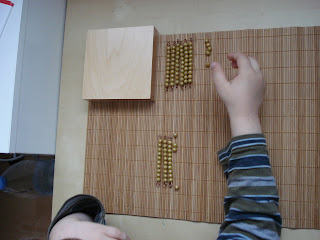
Little-N has worked with the stamp game and small bead frame for years and can already work out long addition and subtraction sums without using materials.  Recently I've been preparing him for multiplication on the small and large bead frame. To prepare him he has revised the following activities.
Long addition and subtraction  using the stamp game.

 Long addition and subtraction using the small bead frame.

Addition and subtractions with millions using the large bead frame.

Little-N worked on these activities well, soon I will be introducing him to multiplication with the bead frames and checker board. 

Wednesday, 3 August 2011

Times Tables


Little-N has been working on his times tables. The Montessori curriculum has plenty of activities to help practice the times tables. We chose the three times table and worked with the following activities.

Multiplication with the bead stair. He wrote out his own question cards, with answer cards and a control of error on the back. He uses his cards to play a memory game.


Multiplication board.


3 bead chain and writing the number sequence.


Multiplication chart looking at the three times table.


Written multiplication chart.


3 times table on the hundred chart.


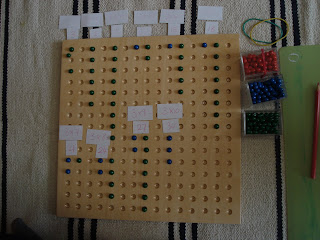
Multiplication on the peg board.

A few years ago Little-N worked with these materials to gain an understanding of multiplication. He has now revisited the material to help him with memorisation of the times tables.
Once he is confident with the three times table, we'll choose another one and work with the materials again.

Saturday, 22 January 2011

Long Multiplication With the Stamp Game

I presented long multiplication with the stamp game to Little-N. There are many steps in this activity and I was worried that he would get confused, but he understood it so well and only needed one presentation.
Here is an outline of the steps:
Question: 105x12


At first he will get 12 green unit skittles and place down the side of the mat to represent the multiplier. He already knows how to do this from working with the stamp game with short multiplication.


He begins to put out the stamps to represent the multiplicand 105. He soon realises that it will take so long if he has to take out 105 12 times.


We discuss another way of making our multiplier 12 in skittles, he decides to use 1 blue ten skittle and 2 green unit skittles.


He begins to put out the stamps to represent the multiplicand 105. We talk about being fair to each skittle, if we give 1 unit skittle 5 unit stamps then we should give 1 ten skittle 5 ten stamps to be equal. Little-N got it straight away.


After all the stamps have been given out Little-N counts and changed where necessary to find the final answer.
His answer is correct. Now lets try a harder question. Little-N then worked with this independently on some much harder questions. I am so proud with the way that he handled this concept of long multiplication, it was like second nature. He later showed my husband how to do it and my husband was confused.

Lesson to be learnt, some of the later Montessori activities and materials will look very difficult and confusing to an adult, however a child who has gone through the Montessori education will be prepared in so many ways so that each new activity is easy to grasp and understand. Little-N understood this activity quickly because he worked with all the sensorial materials, practical life, mathematics materials, he worked through the golden beads and other activities with the stamp game, everything built his understanding of numbers and mathematics so that when he comes to learn harder concepts he is able to easily grasp them. Do not under estimate the power of a Montessori mind!!!


Thursday, 20 January 2011

Bead Stair Extension Activity

I made this activity for children to work with after being presented to the bead stair. For this activity you need:
-A mat
-A bead stair
-Correct number of beads matching the bead stair
-Pipe cleaners cut to different lengths

The child counts and builds the bead stair. He can then sort the pipe cleaners in order of length. The child will start with one, find one red bead and thread it on the first pipe cleaner. Next he will find two green beads and so on.
In the end the child has constructed a bead stair. This activity will provide the child with plenty of opportunity to count 1-10 and recognise the colour coding for each number.

I didn't have bead in the correct colours, so I painted mine and the children still love them.

Thursday, 2 December 2010

Numbers from 1-10

When one of my students first joined in October he would count up to 10 but missed a few numbers here and there. He could recognise 1,2,3 and 5 and then just guessed at the other numbers. After 5 weeks and only 10 days of actually coming to my class he is now ready to move beyond 10. Here are some of the activities he worked with not all the pictures are of him working but he did complete each activity:

Large number rods and cards. That is Little-N when he was three!!! Oh I miss how small he was!

The spindle box

Number cards and counters: All counters should have been the same colour but unfortunately I only had these.

Small number rod and cards.

Sorting the beads, counting and then finding the number card.

Short bead stair matched with the number cards.

Practising times tables


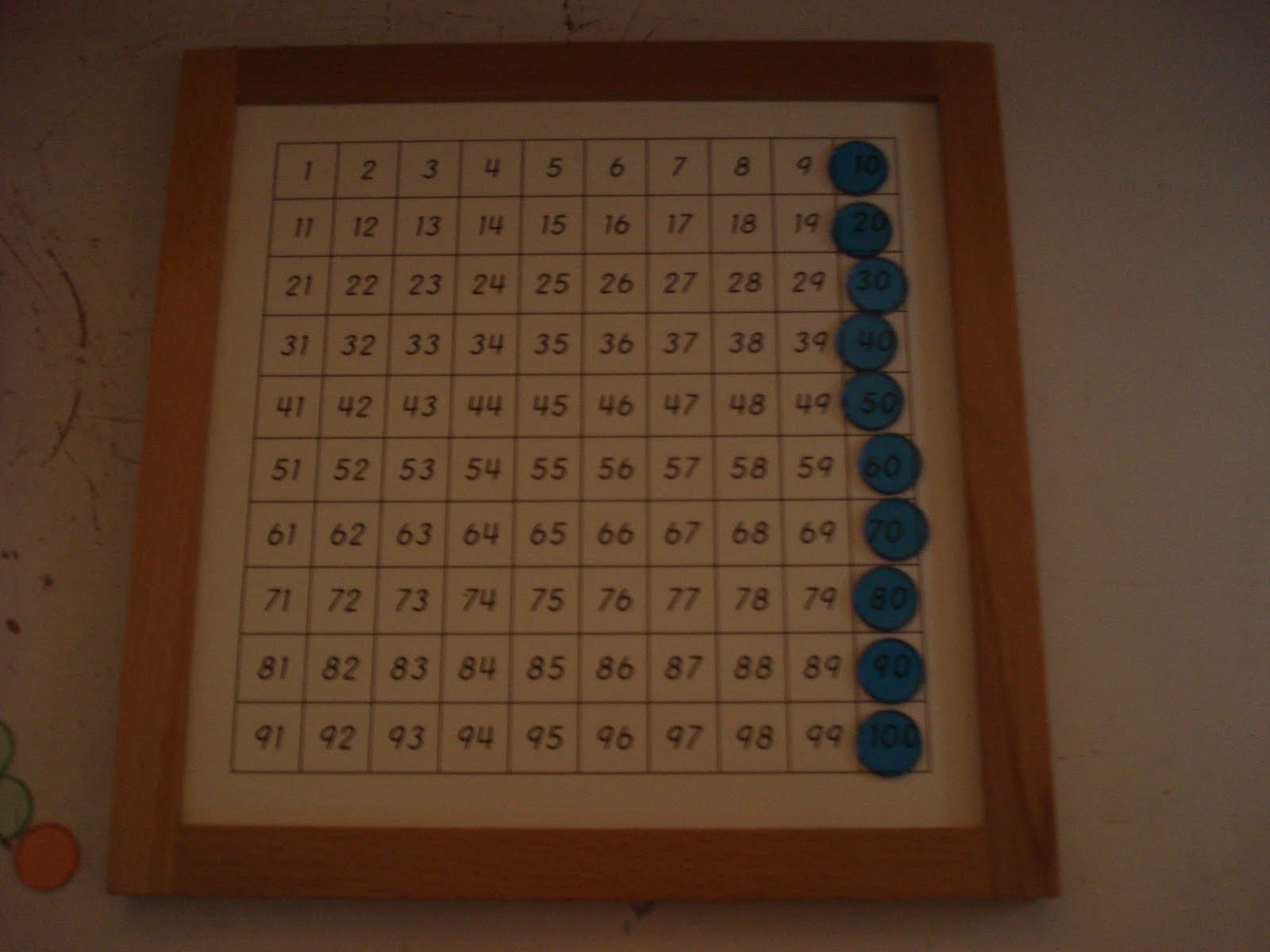
Little-N has been practising his times tables using the hundred board and transparent counters. This activity not only provides the opportunity for him to practice the tables but also allows him to visualise the patterns the each table creates.

Tuesday, 10 August 2010

Beyond 10

When Little-S started with me in June he knew how to count to 100 in French but not in English. I decided to take him through the Montessori materials for counting beyond 10. Here is a list of the Montessori activities for learning to count beyond 10.


Teen beads: Child learns to count from 11-19 using the beads.
Seguin board A: Child learns the symbols for numbers from 11-19.


Seguin board A with beads: Child matches the quantities and symbols from 11-19.


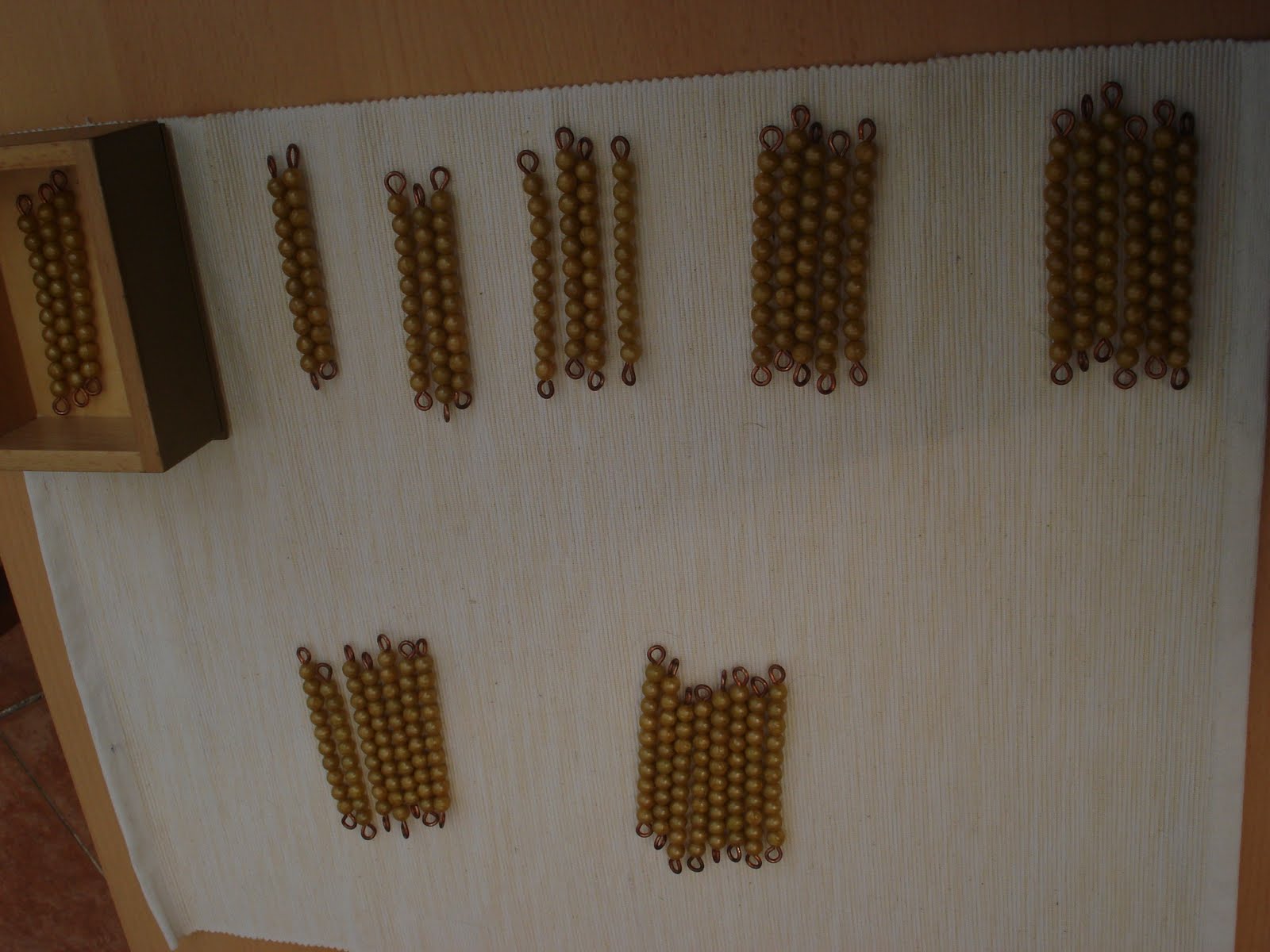
Tens beads: Child learns the quantities 10,20,30,40,50,60,70,80,90.
Seguin board B: Child learns the symbols for 10-90 using the tens board.

Seguin board B and beads 1: Matching the symbols 10,20,30,40,50,60,70,80,90 to quantities.


Tens beads 2: Child counts through the beads starting with 1 and continues adding a unit bead and counting. When the child places 10 unit beads it should change it for a ten bar. Read more about this here.

Seguin Board B 2: counting through the symbols. Child counts from 10 to 99.


Seguin Board B and Beads 2: Child starts from ten and counts through the numbers all the way to 99. He makes each number on the board and matches the beads at the same time.

For further practice with the tens beads I made this activity. Download the file and read more about this here .


Hundred chain: Can be done counting in units or counting in tens. It provides the children with further practice in counting from 1-100 and also ensures that the child really understands the quantity of the hundred square used in golden beads exercises. Read more about it here.

Hundred board: Further practice with symbols from 1-100. Can be used in many ways to reinforce the understanding of numbers from 1-100.